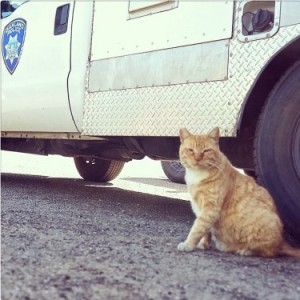
Feral Cats
Oakland Animal Services supports trap, neuter, return as a means of controlling the feral cat population. Please see the information below if you are having problems with feral cats in your area. For information on controlling the feral cat population in your neighborhood, please contact the Fix our Feral’s hotline at 510.433.9446.
Problems with Trap & Remove:
Like all animals, feral cats make their homes where they can find shelter and food. Often this is within close proximity to humans. Because feral cats cannot be easily socialized, they are not good candidates for adoption. Instead, feral cats should be sterilized, vaccinated and returned to their territory.
We understand that not everyone enjoys living with cats and other wildlife in their yards. However, these simple tips will help you divert outdoor cats from specific areas. These quick solutions, coupled with TNR and ongoing management, can help you coexist with your neighborhood cats. TNR is the only effective and humane way to manage feral cat populations. Cats are humanely trapped and taken to a veterinarian, where they are spayed or neutered and vaccinated. Kittens and stray cats that are friendly to humans are placed into loving homes. Healthy, adult feral cats that are fearful of human contact are returned to their outdoor home where they are cared for by volunteers.
Trap-and-Remove doesn’t work. “Trap-and-Remove” is a euphemism for trapping and euthanizing cats. It may seem like a logical solution, but the fact is that it is not effective.
Trap-and-Remove schemes must be done on an ongoing basis and are therefore extremely costly to communities. Survivors will breed prolifically, and new cats will move in to take advantage of resources, quickly forming a new colony. Catch and euthanize is an endless, costly cycle.
Common Concerns:
Cats are lounging in my yard or on my porch.
Explanation: cats are territorial and will remain close to their food source. Ensuring that cats are neutered will dramatically reduce their tendency to roam and keep them from unwanted areas.
Quick Solutions:
- Apply cat repellent liberally around the edges of the yard, the tops of fences and on any favorite digging areas or plants. Available at pet supply stores and at www.gardeners.com.
- Install an ultrasonic animal repellent or a motion-activated water sprinkler, such as the ScareCrow™ or CatStop™ (Contech). Available at www.scatmat.com.
Cats are digging in my garden.
Explanation: it is a cat’s natural instinct to dig and deposit in soft or loose soil, moss, mulch or sand.
Quick Solutions:
- Scatter fresh orange and lemon peels or spray with citrus scented fragrances. Coffee grounds and pipe tobacco also deter cats.
- Plant the herb rue to repel cats or sprinkle dried rue over the garden.
- Obtain Cat Scat™, a nonchemical cat and wildlife repellent consisting of plastic mats that you cut into smaller pieces and press into the soil. Each mat has flexible plastic spikes that are harmless to cats and other animals, but discourage digging. Available at www.gardeners.com.
- Plastic carpet runners, which can be found at local hardware or office supply stores, can also be used when placed spike-side up and covered lightly in soil. Or, set chicken wire firmly into the dirt with sharp edges rolled under.
- Place some of the following over soil: Branches in a lattice-type pattern, or wooden or plastic lattice fencing material artfully arranged. You can disguise these by planting flowers and seeds in the openings. Try embedding wooden chopsticks, pinecones or sticks with dull points deep into the soil with the tops exposed eight inches apart.
- Cover exposed ground in flower beds with large attractive river rocks to prevent cats from digging (they have the added benefit of deterring weeds).
Cats are sleeping under my porch or in my shed.
Explanation: the cats are looking for dry, warm shelter away from the elements.
Quick Solutions:
- Physically block or seal the location the cats are entering with chicken wire or lattice once you are certain the cats are not inside. Be sure to search for kittens before confirming that the cats have left—especially during kitten seasons.
- Provide a shelter (similar to a small doghouse). Or, if they’re feral and part of a nearby managed colony, ask the caregiver to provide a shelter for the cats. Shelters should be hidden to keep the cats safe, and appropriate placement well can help guide the cats away from unwanted areas.
Cats are getting into my trash.
Explanation: cats are scavengers and are looking for food.
Quick Solutions:
- Place a tight lid on your trash can. Exposed trash bags will attract other wildlife as well.
- See if neighbors are feeding the cats. If they are, make sure they are doing it on a regular schedule. If you find no regular feeder, start feeding the cats yourself at a set time, during daylight hours, in an out-of-the-way place. Feeding cats regularly and in reasonable quantities that can be consumed in less than 20 minutes will help to ensure that they don’t rummage through the trash.
There are cat paw prints and/or scratches on my car.
Explanation: cats like to perch on high ground.
Quick Solutions:
- Discourage cats from climbing on cars or other private property by gradually moving their shelters and feeding stations away from such areas into more secluded places.
- Purchase an appropriate cover for the car or other vehicle.
I smell cat urine.
Explanation: tomcats spray to mark their territory as part of their mating behaviors.
Quick Solutions:
- Spray the area thoroughly with white vinegar or with nontoxic products available at pet supply stores.
- The permanent solution is to ensure that the cats are neutered. It will reduce their urge to mark territory and make their urine less pungent.
Cats are yowling, fighting, spraying, roaming and having more kittens.
Explanation: these are all mating behaviors displayed by cats that have not been spayed or neutered, and these cats will breed prolifically.
Quick Solutions:
- Spaying or neutering and vaccinating cats will reduce the sex-drive hormones causing these behaviors. Male cats will stop competing and fighting, spraying and roaming. Females will stop yowling and producing kittens. After sterilization, hormones leave their system within three weeks and the behaviors usually stop entirely. You can find local resources and help at http://www.fixourferals.org.
Feeding the cats attracts insects and wildlife.
Explanation: cats need to be fed under proper guidelines. Leaving food out can attract unwanted animals.
Quick Solutions:
- Keeping the feeding area neat and free of leftover food and trash is of utmost importance.
- Cats should be fed only at a designated time, during daylight hours. They should be given only enough food for them to finish in one sitting. All remaining food should be removed.
- If another person is feeding, ask them to follow these guidelines too.